Pages

Subscribe:
Showing posts with label Stephanie Pratt. Show all posts

Tuesday, 23 December 2014

Day 74 - 7A Eggsperiments With Osmosis - Stephanie Pratt - MSMS Grade 7 Science Teacher

This post first appeared on the Marshall Simonds Middle School Blog
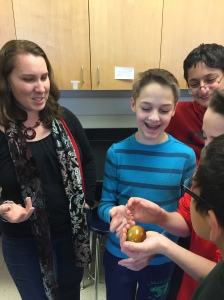
Students share their findings with Mrs. Pratt.
Last week, the students of 7A conducted a series of eggsperiments in Mrs. Pratt’s Life Science class in order to gain a better understanding of how osmosis works. This lab demonstrated the selectively permeable characteristics of a cell membrane when an animal cell is eggposed varying osmotic conditions. Eggs were submerged in household substances such as vinegar, corn syrup, and even Kool-Aid on different days throughout the week, causing alterations in size, color, and texture. This proved to be an engaging, eggciting, and eggceptionally punny lab for the students of 7A.
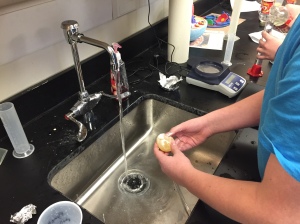
IMG_2447
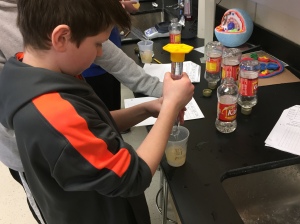
A student “washes” an egg shell off after the egg had been submerged in vinegar for a day. 
IMG_2449
An egg is submerged in corn syrup on the third day of the lab. 
On the last day of the eggsperiment, students observed how their eggs had changed after each group submerged their eggs into a concoction of their own making the day before. The eggs that emerged on the final day of the lab came out in a variety of colors and textures based on the contents of the mixture, with some eggs turning green, purple, orange or black.
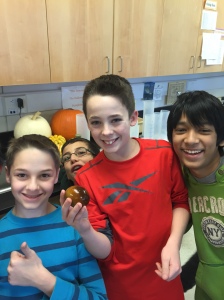
IMG_2464
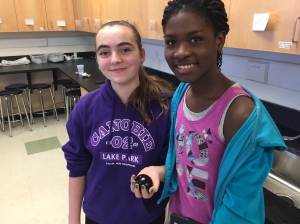
7A students show off their Egg on the last day of the Eggsperiment. 
IMG_2469
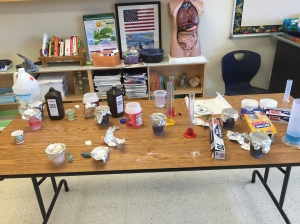
Among the materials used by students over the course of the lab included but weren’t limited to: hydrogen peroxide, vinegar, corn syrup, and kool-aid. 
IMG_2470
“We named her ‘Eggsmerelda’. 
To learn more about this lab and the other great things being done in Mrs. Pratt’s Life Science classes, visit her blog.

Tuesday, 7 October 2014

Day 26 - Brine Shrimp Lab Project - Stephanie Pratt, Marshall Simonds Seventh Grade Science

 This post originally appeared on Mrs. Pratt's Blog

7A students have designed their own experiments to determine the effect of hatching and/or survival of brine shrimp!  Students worked in teams of 4-5 members.
  • First, the students designed their experiment and laid the foundation.  Here's what they did: they wrote a problem and explained their purpose.  Then they wrote a hypothesis they could test.  Last, they drew a diagram of their experiment and listed/obtained materials.

  • Next, students set up their experiments!  What creative ideas they had!  Some of the fantastic ideas that students came up with were:  the effects of different colored lights on the hatching of brine shrimp, the effects of a black light on the hatching of brine shrimp, which pH level can support live brine shrimp survival?, does music allow for better hatching rates of brine shrimp?, what foods allow brine shrimp to survive better?, and finally the effect of temperature on brine shrimp survival/hatching rates.


  • Then, students collected data with their iPads by taking picture and videos to document progress.  Students created diagrams, graphs, and data tables so they could analyze the results of their experiments.  Each team created a shared google doc.  The google doc proved to be an excellent tool to allow students to collaborate on the lab report (students were happy with the success of this, too).  This way each member really could contribute in a meaningful way and they could support one another in learning how to write a lab report.


  • Finally, the teams each created a presentation of about 5-7 slides in Explain Everything app or in the Book Creator app.  They presented their experiments in front of the the class.


Friday, 13 December 2013

Day 70 - "Bubble" Lab - Stephanie Pratt, MSMS Grade 7 Science

This post originally appeared on the Marshall Simonds Middle School Blog


2013-12-09 10.03.52
Students in Mrs. Pratt’s 7th grade science class are learning about the properties of the cell membrane.
2013-12-09 09.04.18
To help students understand the dynamic functions as well as the incredible structure, Mrs. Pratt created a hands-on lab that allows students to explore a simulated cell membrane by using bubbles! The lab asks students to hypothesize how (in what ways) can a soap bubble represent or simulate the structure and function of a cell membrane.
2013-12-09 10.03.38
Soap, like cell membranes, is made of long molecules. One end of the molecule mixes easily with water (a property known as “hydrophilic”), the other end doesn’t mix easily (a property known as “hydrophobic”). As students learn this activity, those different ends account for the way both cell membranes and bubbles form, the shape they take, and how they allow things to pass through them.